Language Development - The Mind of the Other 6 videos

A one-month-old child makes sounds and moves to indicate how she feels. An observant parent can “read” the infant’s internal states and supply what is needed to calm the infant, so credit for the communication goes to the parent. The infant is just doing what is natural – crying or smiling, fretting or laughing. Eventually infants learn the connection: “If I cry, I will be fed”. but that is not the same as realizing someone out there understands the message. So, when do deliberate attempts to communicate to a listener begin and how do these strategies change with maturity? If we see a twelve-month-old point at a dog while looking at her parent, we can feel more comfortable saying the child has an intention to communicate, to share a referent with someone else who has a mind and thus can understand the child’s communication intent.

We have used our Videatives library to create a playlist that illustrates how children’s assumptions about communication change as they mature. (Note – If you are a subscriber to the Video Streaming Service, you too can create playlists that illustrate comparisons of interest to you) Read the following paragraphs that correspond to the video clips listed below this blue text box. Click on the title of each of those video clips to open the video player.

Infants Hold Hands
Is either child aware that the other child can think? You see the child wearing blue reach out to hold the hand of the infant wearing pink. Is this a social act of communication or is it the physical act of grabbing a moving object? To communicate one needs to have an understanding that the other has a mind and is aware of your intention to “speak” or “gesture” a message.

Infants with Teacher: Call and Response
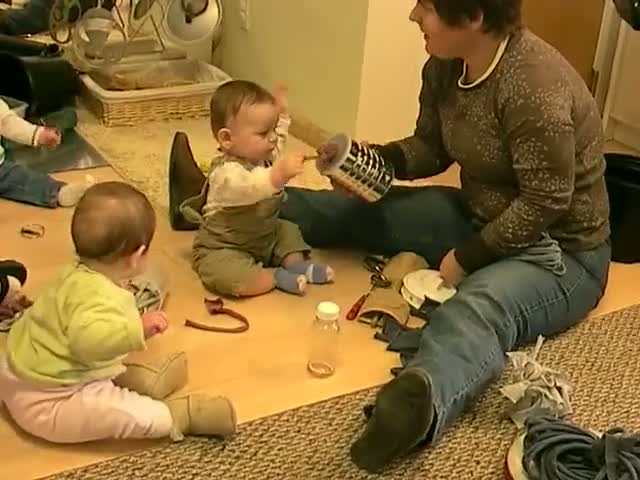
Notice how the teacher invites (communicates a request) the children to sing with her. Are the children aware of the communication intent of the teacher? Do any of the infants expand the rules of making noises to create a sort of game, a game that indicates his/her awareness that he/she is taking turns?

Are They Talking?
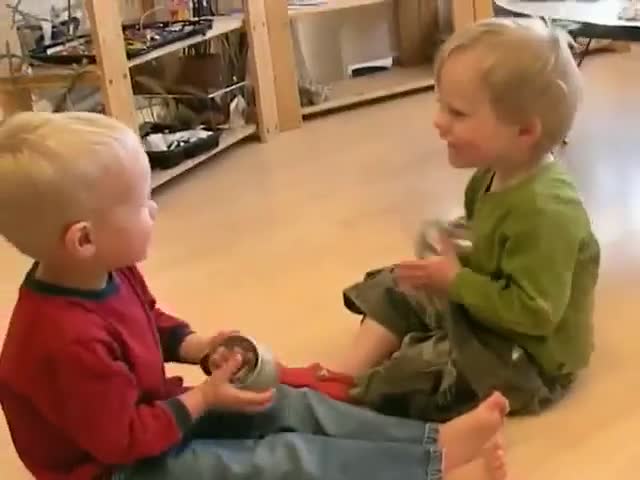
In this clip, the children are the ones who invite each other to listen. Do you see any actions that suggest a child expects to be understood by another child? Speculate about what the children in this video might be thinking as they pronounce these sounds. Here are some possibilities: “I want that”, “That’s funny”, “That’s mine”, “Look at this”, or “I got it”.

Children Read the Quality of Gestures
Here you will see how Justin corrects the way Max represents pretend driving. In essence he is saying, “You are not making the correct gestures,” and thereby Justin is trying to improve Max’s communication.

Can Threes Teach?
Here again, perhaps six months later, we have Justin teaching Max. Justin makes statements about what he wants to communicate, such as when he says, “I will show you how to do it.” Consider if he understands the difference between directly solving the problem of the stuck zipper versus instructing someone else in how to “unstuck” the zipper.

She’s Not Listening
Clearly Avery is thinking about the thinking of her pet dog Jasmine. She assumes that if Jasmine does not do what Avery requests, it is because Jasmine is not listening, as opposed to the possibility that Jasmine does not understand English. Even when children reach an age of understanding that a listener has a mind, they sometimes attribute to that mind more knowledge than reasonable.

  • Click to view

    Infants Hold Hands

    For young infants, gripping another child’s hand is most often a physical rather than a social act. Over time, physical actions such as these develop to include social applications. Take a close look at these two infants who are holding and releasing each other’s hands and speculate on what the…

    Subjects: body

    Ages: infants

    Tags: child-child communication grasping mind of other

  • Click to view

    Infants with Teacher: Call and Response

    In this video clip, four infants and a teacher sit together on the floor exploring objects. As they play one of the infants utters a series of consonant-vowel syllables that sound something like a song verse. She says, “Da-dah, da-dah, dah”. Notice how the teacher treats the infant’s babbling as…

    Subjects: body

    Ages: infants

    Tags: communication teaching children-teacher nonverbal babbling closed captions

  • Click to view

    Are They Talking?

    Before children begin to pronounce words they begin to ‘pronounce’ word-like sounds. If you listen for a while you will realize that these sounds are strung together into a small number of sentence-like patterns used repeatedly. If you watch how children orient to each other as they make these sounds,…

    Subjects: balls

    Ages: ones

    Tags: communication child-child closed captions non-verbal gestures

  • Click to view

    Children Read the Quality of Gestures

    Max and Justin are engaged in pretend play. Notice the flexibility with which the children use the bicycle inner tube as a symbol. The boys seamlessly transform the inner tube into a car seat belt, a possible flotation device for swimming, and a guitar that is strummed energetically. The children…

    Subjects: props

    Ages: twos

    Tags: pretense child-child gestures communication closed captions

  • Click to view

    Can Three-Year-Olds Teach?

    Max cannot close his zipper purse. Justin announces, “I will teach him.” As Justin starts to zip his own purse he tells Max, “Now watch this. I can do it. Hold on the bag and pull.” The zipper moves and opens the bag. Justin looks over at Max, “And then…

    Subjects: zippers

    Ages: threes

    Tags: function mind of other teaching children-teacher closed captions

  • Click to view

    She's Not Listening

    Avery wants her dog, Jasmine, to lay her head on the floor. When Jasmine does not understand what Avery wants, Avery speaks louder and pats Jasmine’s head down firmly. She behaves as if Jasmine is not listening, as opposed to not understanding English. This idea of ‘listener blaming’ is common…

    Subjects: pets

    Ages: fours

    Tags: parent-child communication perspective mind of other animals closed captions